
What is the Ronin token (RON)?
The Ronin token, ticker RON, is the native currency of the Ronin Network — an EVM-compatible blockchain that Sky Mavis originally built in 2021 to get Axie Infinity off congested Ethereum. According to the official Ronin docs, RON serves three jobs at once: it pays for gas (transaction fees), it secures the chain through validator staking, and it anchors liquidity on Katana, the network's built-in DEX. If you've used the Ronin Wallet at all, you've already touched RON — every transfer, swap or NFT mint on the chain consumes a fraction of it.
A detail that trips up newcomers coming from Ethereum: RON is not a token living on someone else's chain. It's the base asset, the same way ETH is on Ethereum or SOL is on Solana. That means there's no contract address for "real" RON on Ronin itself, and — critically — anything labelled "RON" sitting on Ethereum, BNB Chain or Solana is either a bridged wrapper or an outright fake. We'll come back to that in the security section, because it's where people actually lose money.
RON began trading publicly in January 2022 and is listed on major trackers — CoinGecko and CoinMarketCap both classify it among the larger gaming-sector tokens, though its market cap has swung wildly with each gaming cycle. I've watched this sector since 2017, and RON's chart is a textbook mid-cap gaming token: violent rallies when Web3 gaming is fashionable, long grinding drawdowns when it isn't. Keep that in mind before you treat it as anything more than a working utility asset.
Ronin started life as an Ethereum sidechain and has been evolving toward a more independent, validator-secured network under a delegated proof-of-stake model. The chain uses the distinctive ronin: address prefix in its own tooling, but under the hood addresses are standard EVM 0x addresses — the same key works in both formats.
RON token utility: what it's actually used for
Marketing pages love vague phrases like "powers the ecosystem". Here's the concrete breakdown, cross-checked against the official Ronin documentation.
Gas fees
Every transaction on the Ronin Network — token transfers, NFT trades, game actions, swaps — pays a fee denominated in RON. Fees are typically fractions of a cent, which is the whole point of a gaming chain, but you still need a small RON balance to do anything at all.
Validator staking & delegation
Validators must stake RON to earn the right to produce blocks, and regular holders can delegate their RON to validators to share in the rewards. Per the official docs, staking rewards come from a dedicated emissions allocation, not from thin air — more on that below.
Liquidity on Katana
Katana, Ronin's native DEX, routes most trades through RON pairs — RON/WETH, RON/AXS, RON/USDC and so on. Liquidity providers deposit RON alongside another asset and earn trading fees. If you want to trade inside the wallet, see our Ronin swap guide.
Governance direction
Sky Mavis has positioned RON staking as the basis for network governance: validators vote on protocol changes, and the long-term direction described in official material is more community say over upgrades and treasury decisions. Treat "governance" as an evolving promise rather than a finished product — real decision power today still sits heavily with the validator set and Sky Mavis.
Notice what's not on the list: RON isn't required to play most Ronin games (games use their own tokens like AXS or SLP for in-game economies), and holding RON doesn't entitle you to revenue, dividends or anything resembling equity. It's a utility and staking asset, full stop.
RON tokenomics: supply and allocation
According to the official Ronin docs, the maximum supply of RON is capped at 1,000,000,000 (one billion) tokens, with the full supply potentially unlocking over roughly 108 months — nine years — from launch. The allocation splits into four buckets:
| Category | Share of max supply | What it funds |
|---|---|---|
| Community incentives | 30% | Liquidity mining, rewards programs, hackathons, grants and other community distribution |
| Sky Mavis | 30% | The founding company's allocation — team, shareholders and corporate reserves, subject to vesting |
| Staking rewards | 25% | Emissions paid out to validators and delegators who stake RON |
| Ecosystem fund | 15% | Growing the Ronin ecosystem; initially managed by the Sky Mavis core team |
Two honest observations from someone who reads a lot of these tables. First, 30% to the founding company is on the higher side for an L1, though hardly unusual for 2021-era launches. To its credit, Sky Mavis announced in an official Ronin blog post that it would re-lock a large majority of its already-unlocked allocation and vest it quarterly over an extended period — a move that reduced near-term sell pressure. Second, the circulating supply grows continuously as staking emissions and vesting unlocks hit the market. That structural inflation is a headwind for the price that no amount of ecosystem news changes, so always check a live tracker like CoinGecko for the current circulating figure rather than trusting a screenshot.
Unlock schedules get revised. The numbers above match the official docs at the time of writing (July 2026), but if you're making decisions based on supply, verify against docs.roninchain.com and a live aggregator first. Never rely on a third-party article — including this one — for exact, current figures.
How RON shows up in your Ronin Wallet
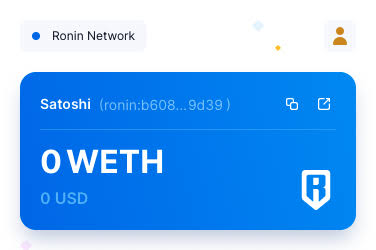
Open the official wallet — browser extension or the Ronin Wallet mobile app — and RON sits at the top of your balance card, right under your ronin: address. The wallet displays your total in RON with a fiat estimate underneath, and a fresh wallet simply shows zero across the board, exactly like the balance screen in the image above.
Below RON you'll typically see the other staple assets of the Ronin economy: WETH (wrapped Ether bridged from Ethereum), AXS (Axie Infinity's governance token), SLP (Smooth Love Potion, the in-game resource token) and USDC (the dollar stablecoin). These aren't random — they're the main Katana trading pairs, and most game economies on Ronin settle into one of them. If you don't have a wallet yet, our step-by-step how to create a Ronin Wallet guide takes about five minutes, and this is a non-custodial wallet: your seed phrase is the only key, and nobody — not Sky Mavis, not any support agent — can restore it for you.
How to get RON
There are three realistic routes: buy it on an exchange and withdraw it to your wallet, earn small amounts through quests and ecosystem programs, or swap another asset for RON on Katana. Buying on an exchange is the standard path for anything beyond pocket change.
Set up your Ronin Wallet first
Install the official wallet from wallet.roninchain.com and back up your seed phrase offline. Full walkthrough in our wallet creation guide. You need your own
ronin:address before you buy anything.Buy RON on a centralized exchange
RON trades on several major exchanges — check CoinGecko's markets tab for current listings. Buy with a card or bank transfer, complete the exchange's KYC, done. Note the trade-off: the exchange is custodial, so those coins aren't truly yours until they're in your own wallet.
Copy your Ronin address
In the wallet, tap your address to copy it. It starts with
ronin:; most exchanges expect the equivalent0xformat — same address, different prefix. The official wallet shows both.Withdraw and select the Ronin network
On the exchange's withdrawal screen, paste your address and — this is the step that ruins people — explicitly select Ronin as the withdrawal network. Not Ethereum, not BNB Chain, not Arbitrum. Ronin.
Send a test amount first
For a first withdrawal, send a small test amount. Wait for it to land in your wallet, then send the rest. Ten minutes of patience versus an irreversible mistake — easy math.
Or swap on Katana instead
Already holding WETH, USDC or AXS on Ronin? Skip the exchange and convert directly inside the wallet — our Ronin swap guide covers slippage, fees and the exact clicks.
Wrong network = burned funds. RON is native to the Ronin Network. If an exchange offers multiple withdrawal networks and you pick Ethereum, BNB Chain or anything else while pasting your Ronin address, your coins will land on a chain where you can't reach them — in most cases they're gone permanently, and neither the exchange nor Sky Mavis will recover them. Always select the Ronin network on withdrawal, and always test with a small amount first.
The "earn it" route is real but modest: the wallet's built-in quests and periodic ecosystem campaigns hand out small RON rewards for completing tasks, and some games distribute RON in events. Treat these as a way to cover gas, not as income — anyone promising meaningful "free RON" outside official Ronin channels is running a scam funnel.
Staking RON: how delegation works
The mechanics
Ronin runs a delegated proof-of-stake system. Validators put up their own RON stake and run the infrastructure; ordinary holders delegate RON to a validator of their choice and receive a proportional cut of that validator's rewards, minus the validator's commission. Your coins never leave your control in the custodial sense — delegation is an on-chain contract, not a transfer to someone's account. Rewards accrue daily and, per the official docs, you can claim them or restake them to compound.
Where do the rewards come from? Emissions. Remember the 25% "staking rewards" bucket in the tokenomics table — staking yield on Ronin is primarily newly released RON from that allocation, plus a share of transaction fees. That matters for expectations: the yield is real, but it's paid in an inflating asset. A 5% nominal yield doesn't help much in a year when the token drops 60%, which — see the volatility section — is a thing that happens to gaming tokens.
The risks, plainly
- Lock-up friction. Per the official docs, after you stake with a validator you must wait at least three days before you can withdraw that stake. Not brutal, but you can't react to a market move instantly.
- Validator choice. If your validator goes offline or misbehaves, it gets penalized — and while it's jailed, you earn nothing. Picking a validator purely by highest advertised rate is how people end up parked on an unreliable operator.
- Slashing. The official Ronin docs describe slashing penalties aimed at validators: an operator that double-signs blocks loses a substantial chunk of its own required stake (the docs cite a 250,000 RON penalty) and is removed from the validator set. The docs frame the direct financial slash as hitting the validator's self-stake, with delegators' main downside being lost rewards while the validator is punished — but rules evolve, so read the current slashing page on docs.roninchain.com before delegating serious money.
- Price risk dwarfs yield. Staking returns a few percent a year; RON routinely moves that much in a day. Staking is a way to earn on RON you already intend to hold — it is not a reason to buy RON.
RON price: the honest version
You won't find a price prediction here, because nobody publishing RON price targets knows the future — they know what gets clicks. What can be said factually: RON is a volatile mid-cap gaming token. Its price history includes both multi-x rallies during Web3 gaming enthusiasm and drawdowns of well over half its value when the sector cooled. Its fortunes are tied to a narrow story — activity on the Ronin Network — which itself leans heavily on a handful of games.
The risk record is real, too. In March 2022 the Ronin bridge suffered one of the largest crypto hacks ever recorded, with roughly $600 million in ETH and USDC drained via compromised validator keys. Sky Mavis reimbursed users and rebuilt the bridge with stricter security, and the network has matured considerably since — but that incident is a permanent reminder that "gaming chain" doesn't mean "low stakes". Size any RON position as what it is: a speculative bet on one gaming ecosystem, made with money you can afford to lose. If someone on YouTube tells you otherwise, check what they're selling.
RON vs AXS vs SLP: which token does what
Newcomers constantly mix these up, because all three live in the same wallet and the same ecosystem. They do completely different jobs:
| RON | AXS | SLP | |
|---|---|---|---|
| What it is | Native coin of the Ronin Network | Governance token of Axie Infinity | In-game resource token ("Smooth Love Potion") |
| Pays gas on Ronin? | Yes — the only gas token | No | No |
| Stakeable? | Yes — validator delegation secures the chain | Yes — within the Axie ecosystem's own staking | No |
| Supply | Capped at 1B per official docs | Capped supply | Uncapped — minted through gameplay, historically highly inflationary |
| Main risk profile | Mid-cap chain token, tracks the whole ecosystem | Tracks one flagship game's fortunes | Farm-and-dump economics; long-term chart is brutal |
The one-line version: RON runs the chain, AXS governs the flagship game, SLP is a consumable earned by playing. You can trade between all three on Katana — the swap guide shows how — but don't confuse holding SLP with holding a stake in the network.
Security: approvals and fake RON
Two token-specific threats deserve their own section, because they're responsible for most RON losses I've seen that weren't seed-phrase leaks.
Token approvals. When you interact with a DEX or game contract, you often sign an approval letting that contract spend a token on your behalf. A malicious or later-compromised contract with an unlimited approval can drain that token whenever it likes. Habits that actually help: approve only what a transaction needs, review what you're signing in the wallet prompt instead of reflex-clicking, and periodically revoke stale approvals with a reputable revocation tool. Modern smart-wallet and account-abstraction features are slowly making this safer in 2026, but the burden is still on you.
Fake RON on other chains. Because real RON exists natively on Ronin, scammers deploy counterfeit "RON" ERC-20 contracts on Ethereum, BNB Chain and elsewhere, seed a bit of liquidity, and wait for people to buy the ticker on a random DEX. If you didn't acquire RON on the Ronin Network or from a major exchange that explicitly lists it, assume it's worthless. Same rule for airdropped tokens appearing in your wallet unannounced: don't touch them, don't visit the URL in the token name.
No legitimate party will ever ask for your seed phrase — not to "verify your staking", not to "unlock rewards", not for "support". Anyone asking is stealing your wallet. The official wallet lives at wallet.roninchain.com; guides like ours explain it, but your keys stay with you.
Ronin token FAQ
Is RON an ERC-20 token?
No. RON is the native coin of the Ronin Network, like ETH is on Ethereum — it isn't a token contract on Ronin, and it isn't an Ethereum asset. Bridged or wrapped representations may exist elsewhere, but any "RON" ERC-20 you find on a random DEX on another chain should be treated as fake until proven otherwise.
Can I pay gas with AXS or SLP?
No. RON is the only gas token on the Ronin Network. Even if your wallet is full of AXS, SLP or USDC, you can't move anything without a small RON balance to cover fees. Keep a few RON parked for gas at all times — fees are tiny, so a little goes a long way.
Where do I see my RON balance?
On the main screen of the official Ronin Wallet — extension or mobile app — right beneath your ronin: address. The balance card lists RON first, followed by other assets like WETH, AXS, SLP and USDC. If a balance looks wrong, check the address on the Ronin block explorer before panicking; the chain is the source of truth, not the app cache.
What is the maximum supply of RON?
According to the official Ronin docs, RON has a hard cap of 1,000,000,000 tokens, allocated 30% to community incentives, 30% to Sky Mavis, 25% to staking rewards and 15% to an ecosystem fund, unlocking over roughly nine years. Circulating supply changes constantly — check CoinGecko for the live number.
Can I lose money staking RON?
Yes, in two ways. First, price risk: staking yield is a few percent a year while RON itself can move far more, in either direction. Second, opportunity and penalty risk: your stake is locked for at least three days after delegating, and if your validator gets punished you earn nothing during that time. The docs direct slashing penalties at validators' own stake, but always read the current rules before delegating.
Do I need RON to play games on Ronin?
You need a small amount for gas whenever a game action touches the blockchain — claiming rewards, trading NFTs, transferring tokens. The games' internal economies run on their own tokens (AXS, SLP and others), so RON is the toll for the road rather than the currency of any single game.
Is RON a good investment?
Nobody can honestly answer that, and this site doesn't do price predictions. Factually: RON is a volatile mid-cap token whose value tracks activity on one gaming network, with ongoing supply unlocks and a history of large drawdowns. If you buy it, do so with money you can afford to lose, and store it in your own wallet rather than on an exchange.
What's the safest way to buy RON?
Buy on a major regulated exchange that lists RON, then withdraw to your own Ronin Wallet — selecting the Ronin network on the withdrawal form and sending a small test amount first. Buying "RON" on obscure DEXes on other chains is how people end up holding counterfeit tokens.
Sources & official references
- Official Ronin Wallet — https://wallet.roninchain.com/
- RON tokenomics — official Ronin docs — https://docs.roninchain.com/basics/tokenomics
- Slashing for validators — official Ronin docs — https://docs.roninchain.com/protocol/validators/slashing
- Ronin Network official site — https://roninchain.com/
- Ronin (RON) on CoinGecko — https://www.coingecko.com/en/coins/ronin